Normatec Boots vs. Cold Plunge vs. Massage Gun: What Actually Helps Recovery

Short answer
- Compression boots: best evidence is for feeling less sore. Zero timing risk. Use whenever. $1/min or $25/month.
- Cold plunge: powerful, but don't use it straight after lifting. A 2021 Frontiers review found it blunts strength gains (−0.50 dynamic 1-RM, −0.65 isometric). Fine after games, conditioning and endurance work.
- Massage gun: thinnest evidence. Short-term range of motion and soreness only. A convenience tool.
- If you only use one: compression boots, because they're hardest to use wrong.
Three tools show up in almost every recovery lounge in the country. Compression boots, a cold plunge, a massage gun. And they get talked about like they're interchangeable, grab whichever's free, feel better, go home.
They're not interchangeable. They do different things, the evidence behind each is wildly different in quality, and one of them, used at the wrong moment, quietly undoes the session you just finished.
Compression boots: the safe bet
What they do. Chambers wrapped around your leg inflate in sequence from the foot up, hold, release, repeat. Mechanically that pushes fluid back toward your trunk and briefly increases blood flow through the limb.
What the evidence supports. Honestly? Mostly the subjective stuff. Reduced soreness and better perceived recovery hold up a lot better than hard performance outcomes. Boots probably won't make you lift heavier tomorrow.
But your legs feeling less heavy is not nothing, especially mid-season, in a heavy block, or after a day on your feet.
Their real advantage is that you can't get the timing wrong. No training interference, no thermal stress, no rules. Same hour as a lift, the evening after a long run, a rest day. Twenty to thirty minutes is normal. $1 a minute, or $25/month unlimited.
If you've got a circulatory condition or a history of blood clots, talk to a practitioner first.
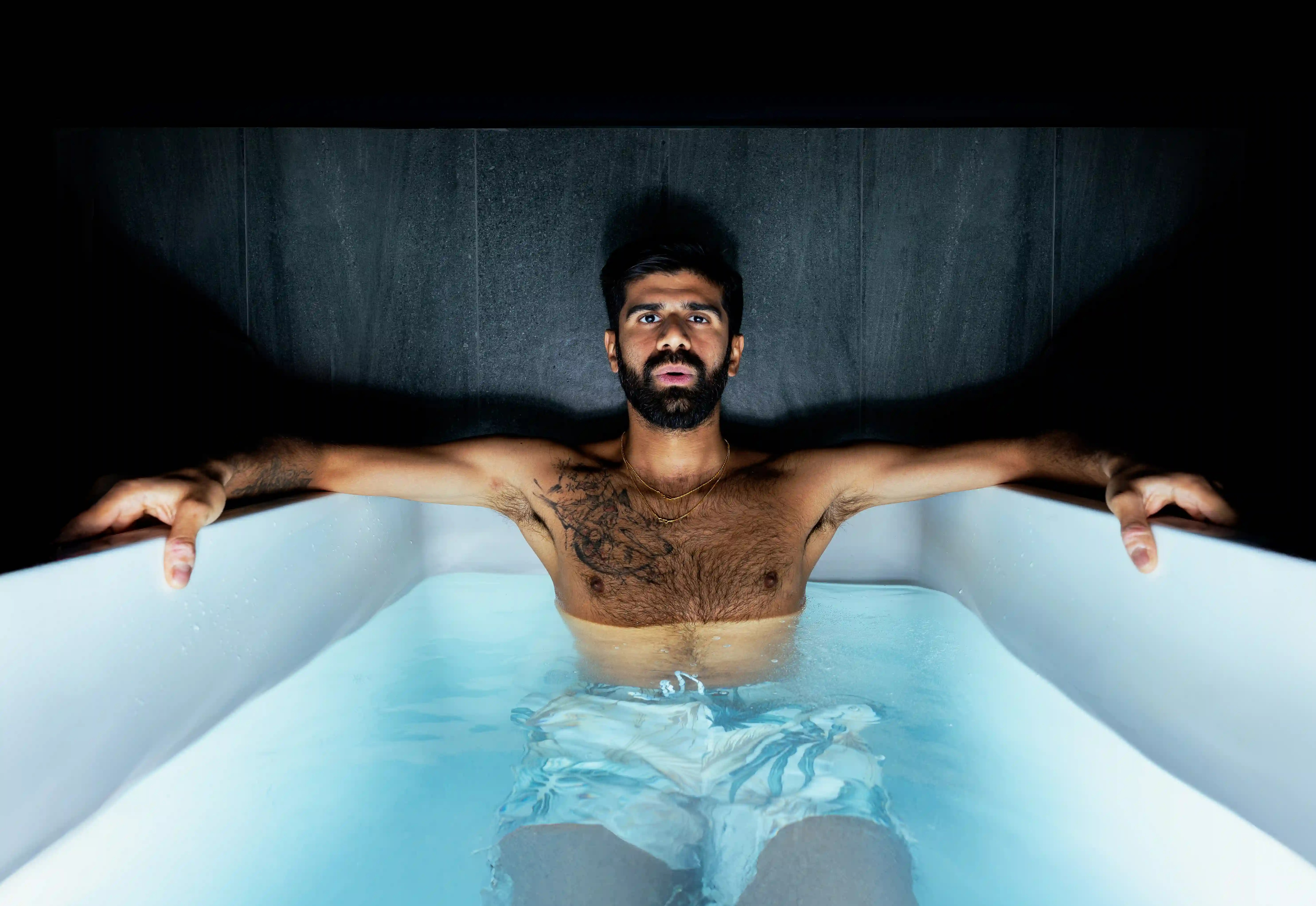
Cold plunge: powerful, easy to get wrong
This is the one people misuse, and it's worth spelling out why.
Cold water immersion works. It reduces soreness, cuts the feeling of fatigue, and gets athletes back out there feeling readier. The problem is that some of the inflammatory signalling it suppresses is the same signalling your body uses to build muscle after lifting.
The research is consistent about this. A 2021 review in Frontiers in Sports and Active Living found post-exercise cold water immersion attenuates resistance-training adaptations, pooled effect sizes of −0.50 on dynamic 1-RM strength and −0.65 on isometric strength. Both studies that looked directly at muscle fibres found reduced type II fibre growth, your fast-twitch fibres, the ones with the most growth potential. Three of six studies showed attenuated whole-muscle growth. In one trial, countermovement jump peak force went up 5% in controls and down 3% with cold immersion.
The protocols were unexotic: 8–15°C for 10–20 minutes, or three rounds of four minutes. Warmer and longer than we run, and there's no reason a colder shorter dose would dodge the effect.
Two things to say alongside that. Endurance adaptations weren't affected, so this is a lifting problem, not a blanket one. And none of it means cold plunging is bad. It means timing decides whether it helps you or costs you.
The rule: if the session you just finished was about size or strength, don't plunge right after. Leave a few hours, or plunge on non-lifting days. If it was about feeling recovered, a match, a tournament, a race, hard conditioning, plunge away. Competition weekends are exactly what this is for.
Temperature and duration. Our tubs run at 3–4°C (37–39°F) at both locations. Research protocols typically use 8–15°C, so ours are colder, and that shifts the dose. Sessions of 30 seconds to 3 minutes rather than the 2–10 minutes you'll see quoted for warmer water. A sensible weekly target is around 11 minutes of total cold exposure across three to five sessions. Because the temperature is fixed, your progression is in duration rather than in dialling the tub down.
Safety. Anyone with a cardiovascular condition, high blood pressure, or who is pregnant should speak to a doctor first. Get in gradually, keep your breathing slow, don't do early sessions alone, and get out if you go numb or can't steady your breath.
Massage guns: useful, oversold
The most-owned and least-studied of the three. The evidence is thinner and the effects that show up are short-term, some improvement in range of motion for a window afterwards, some reduction in perceived soreness. Evidence for meaningful changes in strength, performance or tissue structure is weak.
That doesn't make it useless. It makes it a convenience tool. Portable, free per use, handy for a tight calf before a run or a stiff back at a desk.
Treat it as the thing you reach for between appointments, not a replacement for compression, cold, or hands-on treatment from someone who can assess what's going on.
The decision table
| Your Goal | Use | When |
|---|---|---|
| Building strength or muscle | Boots, or a massage gun | Any time. Keep plunging hours away from lifting, or on off days |
| Competition day | Cold plunge | Between rounds or straight after, feeling fresh is the goal |
| In-season match recovery | Plunge, then boots | Same evening, or the next morning |
| General soreness, desk stiffness | Boots; gun between visits | Any time, no rules |
| Sleep and stress | Contrast therapy | Evenings or rest days |
| Endurance block | Cold plunge | Freely, endurance adaptations aren't affected |
Where we fit
Our recovery lounge is set up so you can use these in sequence instead of picking one and hoping. Our contrast sequence is sauna, shower, cold plunge, repeat, which most people find far easier to tolerate than a standalone plunge.
Drop-in: Recovery Session $30 for a 30-minute plunge. Full Recovery $45 for 45 minutes of sauna, plunge and compression boots. Duo Session $60 for a shared 60 minutes. Boots alone $1/minute or $25/month.
Using it more than twice a month? The memberships are cheaper. Both include 30 minutes of contrast therapy.
The Social Butterfly, $70 + tax/month on 12 months ($90 on 3 months). Unlimited daily access, up to two people per session, towel service, weekly reservations.
The High Performer, $150 + tax/month on 12 months ($180 on 3 months). Adds private reservations, 30-day advance booking, 30 minutes of lymphatic boots, one guest per visit.
Same options at both locations. Call (905) 783-8423 if you'd rather have a practitioner work out where these fit in your week than guess.
Last updated: September 2026
The recovery variable that beats all three tools
Something worth saying in an article about recovery equipment: none of these three tools is the most important thing you do for recovery. Sleep is. It isn't close.
There's no device in our lounge that compensates for six hours a night, and if you're chronically short on sleep the honest advice is to fix that before you spend money on anything with a compressor in it.
The related one is under-fuelling. People training hard on inadequate protein and calories often read persistent soreness as a recovery-tool problem when it's an intake problem.
Both of those are naturopathic territory rather than physiotherapy territory. Naturopathic medicine is regulated in Ontario by the College of Naturopaths of Ontario, and NDs can order certain blood work, which matters if fatigue has a cause worth finding rather than a habit worth changing. Our naturopathic doctors are Dr. Jennifer Tang and Lisbeth Bitar Patino.
One honest note while we're here: magnesium gets sold hard as a recovery supplement. The evidence for supplementing it in people who aren't deficient is thin. An ND will test rather than assume, which is the point.
Which of these do you actually need?
The CareMap scores you across Readiness, Recovery, Activity, Capacity, Health and Mindset in seven questions and under two minutes. No sign-up, PDF at the end, clinician review before your first session.
If Recovery comes out as a top-three focus area, this article's decision table is your next step. If it doesn't, and Capacity or Mindset does, then buying recovery sessions is solving a problem you don't have.
Frequently Asked Questions
The evidence is strongest for the subjective outcomes, reduced soreness and improved perceived recovery. Support for hard performance gains is weaker. They probably won't make you lift heavier tomorrow, but most people find their legs feel noticeably less heavy afterwards, which matters in a heavy training block.
Not if the goal is size or strength. A 2021 review in Frontiers in Sports and Active Living found post-exercise cold water immersion attenuates resistance-training adaptations, with effect sizes of −0.50 on dynamic 1-RM and −0.65 on isometric strength. Leave several hours, or plunge on non-lifting days.
Our tubs run at 3 to 4 degrees Celsius at both locations, which is colder than the 8 to 15 degrees used in most research protocols. At that temperature sessions are shorter: thirty seconds to three minutes. A practical weekly target is about eleven minutes of total cold exposure across three to five sessions.
No. Evidence for percussive therapy is thinner and mostly short-term, showing modest range-of-motion and soreness effects. A massage gun is a convenience tool for between appointments, not a replacement for compression, cold water immersion, or hands-on treatment from a therapist who can assess you.
Anyone with a cardiovascular condition, high blood pressure, or who is pregnant should speak to a doctor first. Enter gradually, keep breathing slow and controlled, don't do early sessions alone, and get out immediately if you experience numbness or difficulty breathing.
Contrast therapy alternates heat and cold. At Revibe the sequence is sauna, shower, cold plunge, repeat. Thirty minutes of contrast therapy is included in both membership tiers. The Social Butterfly at $70 plus tax monthly and The High Performer at $150 plus tax monthly.
Sources
- Frontiers in Sports and Active Living (2021), narrative review, cold water immersion and training adaptation. doi:10.3389/fspor.2021.660291
- Journal of Applied Physiology (2019), cold water immersion, anabolic signalling and fibre hypertrophy. doi:10.1152/japplphysiol.00127.2019
- Coldture and Plunge manufacturer guidance; Cold Water Safety on breath-hold and cold shock thresholds.