Your First Cold Plunge: What Actually Happens

Short answer
- Temperature: our tubs run at 3-4°C (37-39°F). That is properly cold, colder than most recovery protocols in the research.
- Duration: at this temperature, short. 30 seconds to 3 minutes for most people, and 30 seconds is a legitimate first go.
- Weekly target: roughly 11 minutes of total cold exposure a week, across three to five sessions. Not per session.
- Supervised first sessions. At 3-4°C the cold shock response is severe. You will not be left alone.
- The first 30 seconds involve an involuntary gasp and fast breathing. That's the cold shock response — a reflex, not a warning. Control the exhale and it settles.
- Don't plunge straight after lifting if you're chasing strength or size. Fine after games and conditioning.
- Talk to a doctor first if you have a heart condition, high blood pressure, or you're pregnant.
Nobody books a cold plunge worried that it won't work.
They book it worried about the first thirty seconds.
So this is a straight account of a first session: the temperature, how long you're in, what your body does to you, what it feels like, and who ought to check with a doctor before they try it. No wellness language. No promises about inflammation. And an honest note at the end about the one time of week when cold plunging quietly works against you.
The equipment and the temperature
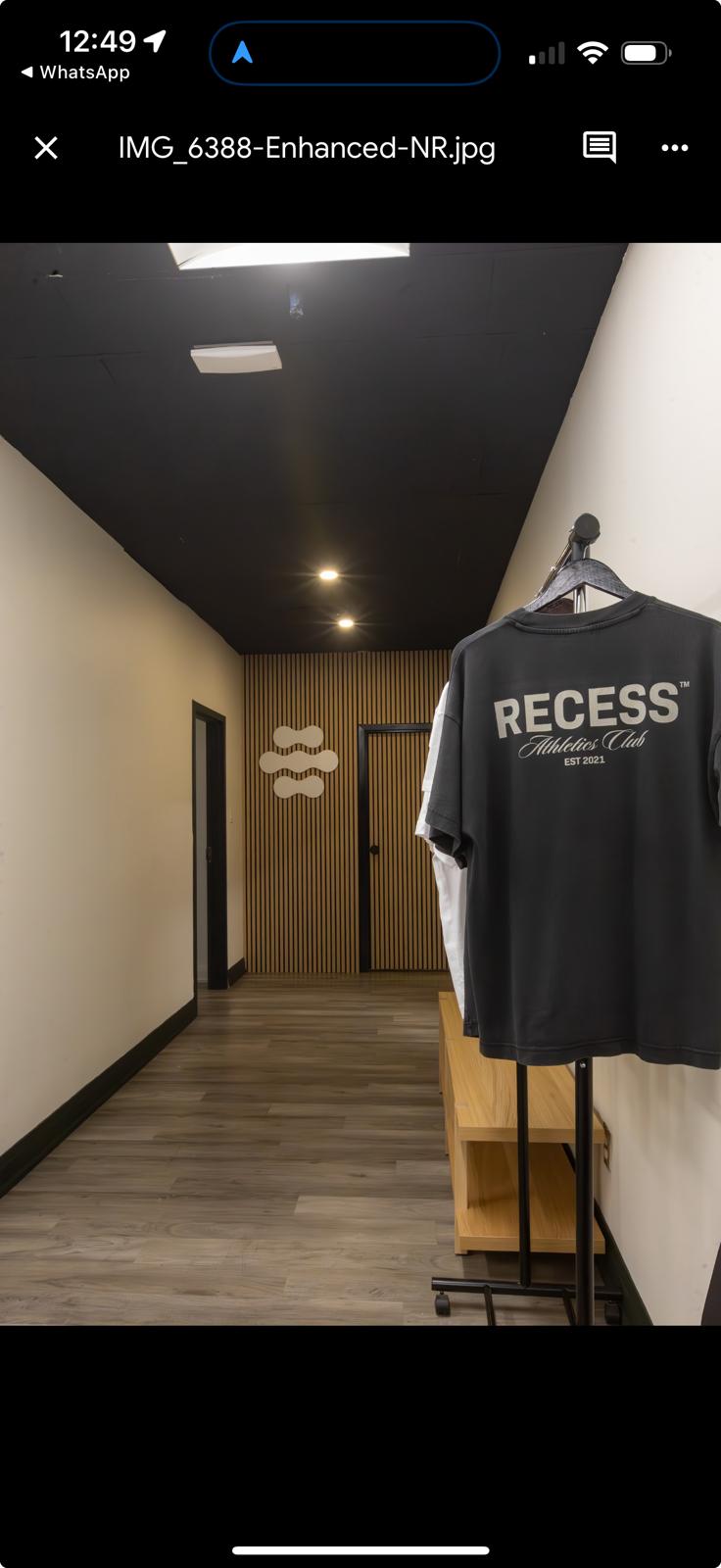
Markham, inside Recess at 220 Torbay Rd, runs a Coldture cold plunge and a Coldture infrared and steam sauna in the same space. Mississauga runs a Plunge tub. Both locations sit at the same temperature.
Most clinics won't tell you what that temperature is, and it's the single most-searched question in the category. So:
3 to 4°C. Around 37 to 39°F.
That is cold. It's colder than most of the recovery protocols you'll find in the research literature, which typically sit between 8 and 15°C. It's colder than the sea off Newfoundland in March.
Two things follow from that, and they're the whole reason this article exists.
One: the dose is time, not temperature. At 11°C you might sit for eight minutes. At 3-4°C, 30 seconds to 3 minutes does the job, and pushing past that isn't brave, it's just uncomfortable for no extra return.
Two: the first thirty seconds are genuinely severe at this temperature, not merely unpleasant. Below 15°C your breath-hold capacity drops to about a third of normal. One study at 5°C found average breath-hold falling from 45 seconds to under 10. Below 7°C, real pain gets added to the equation.
None of which means don't do it. It means do it properly, with somebody there, and don't let anyone tell you that toughing out ten minutes is the goal.
How long you stay in
Thirty seconds to three minutes. At 3-4°C that's the working window, and a first session belongs firmly at the bottom of it.
Thirty seconds is a real plunge. Not a failed one. If you get in, control your breathing, and get out after half a minute, you have done the thing.
The number that surprises people is the weekly one. A practical target is around eleven minutes of total cold exposure per week, across three to five sessions. Eleven minutes across a week. Not per session.
At our temperature that maths works out at roughly two to three minutes a session, three or four times a week. Which is a very manageable habit and nothing like what people imagine when they picture cold plunging.
We'd normally suggest starting at a warmer setting and working down as you adapt, but our tubs run at a fixed temperature, so your progression is in duration instead. Thirty seconds this week. A minute in a fortnight. Let it build.
The first thirty seconds, minute by minute
Getting in. Go gradually rather than dropping. Feet, legs, then sit. Rushing triggers a sharper response and makes the breathing harder to control.
0-30 seconds: the cold shock response. You gasp, hard, possibly several times. Your breathing rate jumps, your heart rate rises, your skin stings and at this temperature it genuinely hurts.
This is a reflex, not a warning sign, and it's the part that ends. At 3-4°C it's stronger than most people expect, which is exactly why we stay with you for it.
Your only job here is your breath. Long exhale, slower than feels natural. Control the exhale and the gasping settles within about thirty seconds. This is why we don't leave first-timers alone — not because it's dangerous, but because someone talking you through the breathing is the difference between two minutes and ten seconds.
30 seconds-2 minutes. The sting fades into a duller, more uniform cold. Breathing normalizes. This is usually where people realize they can do it, and the shoulders drop.
2 minutes on. Steady. You know you're cold and it's no longer urgent. Numb fingers and toes are normal. At our temperature, most people are getting out around here and that's the right call.
Get out if you start shivering uncontrollably, go pale, or can't steady your breathing. Those are the signals to respect.
Getting out. You'll feel warm and alert, sometimes for hours. Dry off, move around a bit, and let your body rewarm on its own instead of jumping into a hot shower.
Why the sauna makes it easier
Our sequence is sauna, shower, cold plunge, repeat, and both membership tiers include 30 minutes of contrast therapy.
Going into cold from a warm sauna makes an enormous difference. The cold shock response is blunted, the transition is far more manageable, and most people who found a standalone plunge unbearable find contrast comfortable.
So if your first attempt at cold immersion put you off, try it after ten minutes in the infrared and steam sauna instead. Different experience entirely.
Two or three rounds is typical. Finish on whichever leaves you feeling better. No rule says you have to end cold.
Who should talk to a doctor first
This matters, and most cold plunge marketing skips it.
Speak to your doctor before your first session if you have:
- A cardiovascular condition, including any heart rhythm problem
- High blood pressure
- A history of stroke
- Raynaud's phenomenon or another cold-sensitivity condition
- Epilepsy or a seizure history
- Diabetes with reduced sensation in the hands or feet
- Are pregnant
Cold immersion causes a rapid rise in heart rate and blood pressure and a sharp involuntary change in breathing. At 3-4°C that response is at the strong end, not the mild end. For most healthy adults it's unremarkable and over in half a minute. For a compromised cardiovascular system it's a genuine stress, and it deserves a conversation with your doctor rather than an assumption.
Regardless of health, at this temperature: never plunge alone, and never on your first several visits without a staff member present. Get in gradually rather than dropping. Keep your head above water throughout, because the gasp reflex and a submerged head is the actual mechanism behind cold water drownings. Get out on spreading numbness, shivering you can't control, or breathing you can't steady. Never plunge after drinking alcohol.
What to bring
Swimwear, a change of clothes, water. Towels are provided. That's it.
The one time not to plunge
Here's something against our own interest, because it's true and you'd find out eventually.
If you've just finished lifting and your goal is muscle or strength, don't plunge right after.
A 2021 review in Frontiers in Sports and Active Living found post-exercise cold water immersion blunts the adaptations resistance training produces, with pooled effect sizes of roughly -0.50 on dynamic 1-RM strength and -0.65 on isometric strength. Both studies that looked directly at muscle fibres found reduced type II fibre growth. In one trial, countermovement jump peak force rose 5% in controls and fell 3% with cold immersion.
The protocols in those studies used 8-15°C for 10-20 minutes, which is warmer and longer than what we run. There's no reason to think a colder, shorter exposure escapes the effect, so treat the timing rule as applying here too.
Endurance adaptations weren't affected. That narrows the problem a lot.
| If You Just Did | Plunge? |
|---|---|
| Strength or hypertrophy session | Wait several hours, or use a non-lifting day |
| A game, match or competition | Yes, feeling recovered is the point |
| Hard conditioning or a long run | Yes |
| An endurance block | Yes, freely |
| Nothing, you came for the plunge | Yes, any time |
None of this makes cold plunging worse. It means the timing decides whether it helps you or costs you, and almost nobody tells you which.
What it costs
Drop-in: Recovery Session $30 for a 30-minute plunge. Full Recovery $45 for 45 minutes of sauna, plunge and compression boots. Duo Session $60 for a shared 60 minutes.
Memberships, same at both locations:
- The Social Butterfly, $70 + tax/month on 12 months ($90/month on 3 months). Unlimited daily access, up to two people per session, 30 minutes contrast therapy, towel service, weekly reservations.
- The High Performer, $150 + tax/month on 12 months ($180/month on 3 months). Unlimited daily access, private reservations, 30-day advance booking, 30 minutes contrast therapy, 30 minutes lymphatic compression boots, one guest per visit.
Plunging more than twice a month? The membership's cheaper. Not sure you'll stick with it? Book a drop-in first — we'd rather you tried it once than signed up for twelve months on a whim.
Book at Revibe Markham, compare memberships, or call (905) 783-8423. Monday to Friday 9-7, Saturday 10-4. We're at 220 Torbay Rd, serving Markham, Richmond Hill, Vaughan, Stouffville and the wider GTA.
General information, not medical advice. If any of the conditions above apply, speak to your physician first. Last updated: September 2026
If you find cold much harder than everyone else
Most people struggle with their first plunge. That's the cold shock response and it's normal.
But if you're someone who is cold all the time, who never warms up after a session when everyone else has, who feels wiped out for hours afterwards rather than alert, that's a different observation and it's worth mentioning to somebody.
Thyroid function, iron status and anaemia can all affect cold tolerance. None of that is a reason to avoid the plunge, and none of it is something we can assess here. It's a blood test.
Naturopathic medicine is regulated in Ontario by the College of Naturopaths of Ontario, and NDs can draw blood for certain tests, so this is a reasonable place to take that question. Our naturopathic doctors are Dr. Jennifer Tang and Lisbeth Bitar Patino, both at Revibe.
If you're on the contraindication list and want to work out whether cold exposure is sensible for you, have that conversation properly rather than deciding on a website's say-so — ours included.
Should you be plunging at all?
The CareMap is seven questions and under two minutes, no sign-up. It scores you on Readiness, Recovery, Activity, Capacity, Health and Mindset, returns your top three focus areas as a PDF, and matches you to what would help, with a clinician reviewing it before your first session.
Worth doing before you buy a membership. If Recovery is one of your top three, contrast therapy is a sensible spend. If it isn't, and Capacity or Health is, you may get more from the training side or the naturopathic side than from the cold water.
Frequently Asked Questions
Our tubs run at 3 to 4 degrees Celsius, around 37 to 39 Fahrenheit, at both locations. That's colder than most protocols in the research, so sessions are shorter: thirty seconds to three minutes. Thirty seconds is a legitimate first plunge. A practical weekly target is about eleven minutes of total cold exposure across three to five sessions.
The first thirty seconds involve an involuntary gasp, faster breathing and a stinging sensation — the cold shock response, which is a reflex rather than a warning. Controlling your exhale settles it within about thirty seconds. After that it becomes a duller, manageable cold.
Speak to your doctor first if you have a cardiovascular condition, high blood pressure, a history of stroke, a cold-sensitivity condition like Raynaud's, epilepsy, or diabetes with reduced sensation, or if you're pregnant. Never plunge after drinking alcohol, and avoid doing early sessions alone.
Not if your goal is muscle or strength. A 2021 review in Frontiers in Sports and Active Living found post-exercise cold immersion blunts resistance-training adaptations, with effect sizes around -0.50 on dynamic 1-RM strength. Leave several hours, or plunge on non-lifting days. Endurance adaptations aren't affected.
Considerably. Entering cold water from a warm sauna blunts the cold shock response and makes the transition far more manageable. Many people who found a standalone plunge unbearable find contrast therapy comfortable. Our sequence is sauna, shower, cold plunge, repeat — two or three rounds is typical.
A drop-in Recovery Session is $30 for a 30-minute plunge. Full Recovery is $45 for sauna, cold plunge and compression boots over 45 minutes. Memberships start at $70 plus tax monthly on an annual term and include 30 minutes of contrast therapy with unlimited daily access.
Sources
- Coldture and Plunge manufacturer guidance on temperature, duration and contraindications.
- Frontiers in Sports and Active Living (2021), cold water immersion and resistance-training adaptation. doi:10.3389/fspor.2021.660291
- Journal of Applied Physiology (2019), cold water immersion, anabolic signalling and fibre hypertrophy. doi:10.1152/japplphysiol.00127.2019